
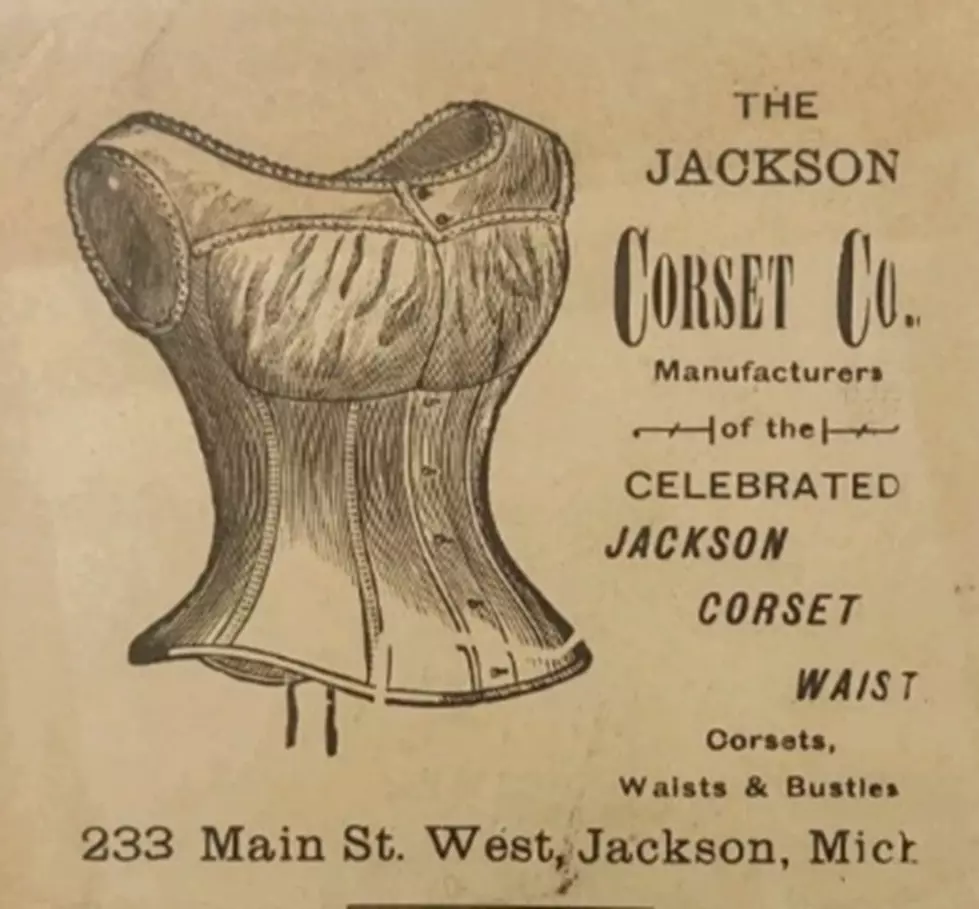
When Jackson Ruled the U.S. in Corsets: 1875-1921
When the city of Jackson, Michigan is mentioned, what's the first thing you think of?
Why, corsets of course.
You know, kinda like girdles.....cinchers and fatstoppers.
Jackson is well-known for a number of things, and back in the 1800s, corsets were king. It may be difficult for some people to fathom in the 2020s, but Jackson was the Corset Capital of the United States.

Corsets of the 1800s were made from whalebone or steel and was meant to squee-e-eeze a woman's waist to extreme measures in order to fit into those thin-waisted dresses of the era that women were anxious to wear. They had to be fashionable (a/k/a have an hourglass figure), right?
In the 1800s, Jackson was a corset mecca. A local company named Bortree invented a duplex corset in 1875 that gave Jackson a huge push into the business of making women look slimmer, or to some, more fashionable.
At its girdle apex, Jackson had an unheard-of sixteen corset companies, most of them lining up and down Cortland and Pearl streets.
The Bortree Corset Company, founded in 1868, was located at 112 W. Cortland and was the first American corset manufacturer located outside of New York City.
The Coronet Corset 'Manufactory' opened in 1880 at 146 W. Main Street, re-locating to 131 W. Pearl Street.
The Jackson company that wound up being the largest corset manufacturer in the entire country was the Jackson Corset Company, founded in 1884 at 209 W. Cortland Street.
Other Jackson corset companies included:
American Lady Corset Company
I.M. Dach Company
Jackson Skirt & Novelty Company
Kellogg Corset Company
Reliance Corset Company
S.H. Camp Company
Standard Manufacturing Company
If the business was so successful in Jackson, why did it disappear?
The demand for corsets declined in 1921. The 1920s was the “era of the Flappers” - women that preferred wearing loose clothes that weren’t so restrictive, allowing them to cut loose much easier when doing the new wild dances (like the 'Charleston’) that permeated the 1920s.
That, plus the creation of new elastic materials that were used to make new, more comfortable girdles and underwear.....plus, they were easier to manufacture.
The few Jackson companies that remained began manufacturing and selling therapeutic wear.